Open Source · 2025
VLC 4.0 Contributions
Artist Albums functionality and related media-library work in VLC 4.0's Qt/QML interface, contributed through Google Summer of Code 2025.
- Role
- Google Summer of Code Contributor
- Period
- Google Summer of Code 2025
- Type
- Google Summer of Code contribution
- Organization
- VideoLAN
- Category
- Open Source
- Technologies
- C++ · Qt · QML · VLC Media Library · SQLite · Git · GitLab
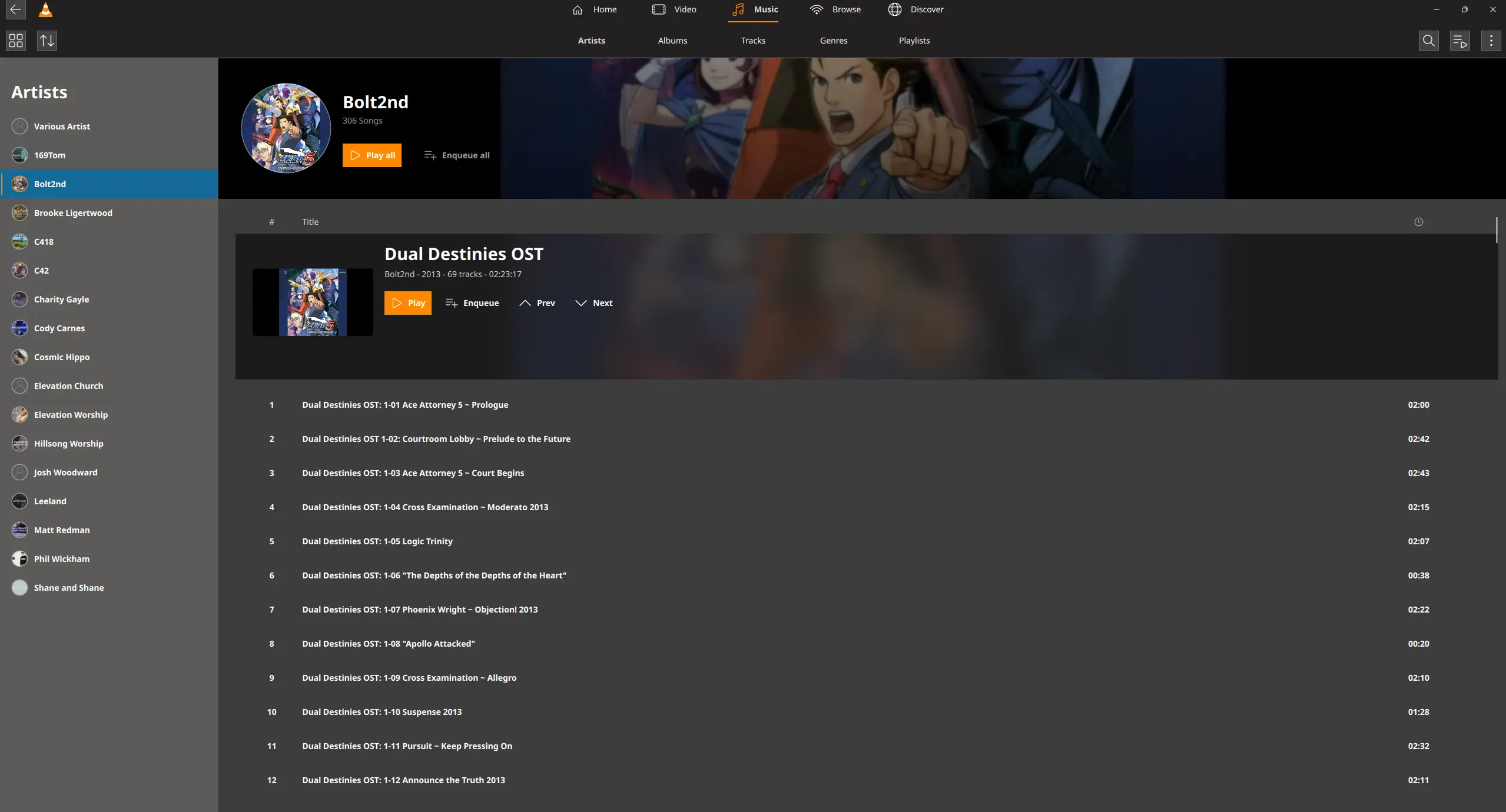
These are my contributions to VLC 4.0 during Google Summer of Code 2025 with VideoLAN. The work centres on Artist Albums functionality, spanning QML, C++ and the media-library layer. It is a set of contributions to VLC, not authorship of VLC or of its media library as a whole.
Context#
VLC is an established, cross-platform open-source media player. The work meant learning a mature codebase and adding user-facing behaviour that respects the existing architecture, interfaces and review conventions, rather than building a standalone screen.
What I contributed#
- The Artist Albums view and related UI behaviour in VLC 4.0.
- Album-grouped browsing and navigation flows.
- Playback and search interactions associated with albums and artists.
- QML views, delegates and component integration with the C++ application layer.
- Media-library interactions, including album-related search queries and handling of identifiers.
- Sticky, pinned section behaviour for album-grouped views.
- Performance and memory refinement around QML and shader resource management.
~30%
GPU memory reduction
Project-specific observation tied to shader / interface resource lifecycle management. Not a claim about VLC overall; test conditions to be documented.
Engineering challenge: integrating with a mature codebase#
The changes crossed several layers: C++ application structures, Qt/QML interface components, and media-library data access. The difficulty was making the feature behave consistently with VLC’s existing navigation and playback model.
Engineering challenge: memory and performance#
Earlier project documentation reports an approximately 30% reduction in GPU memory pressure associated with lifecycle management of shader or interface resources.
Source contributions#
Individual contributions are reviewed in VideoLAN’s GitLab:
- Merge request !7485 (Original Merge Request)
- Merge request !7985 (MR superseding my original MR)
- Google Summer of Code 2025 project page
What it demonstrated#
Working inside a large C++/Qt codebase: understanding unfamiliar subsystems, developing user-facing functionality, responding to code review, and paying attention to runtime performance.